The complete Pokhara-to-Pokhara guided teahouse expedition reaching Annapurna Base Camp (4,130m) via Ghorepani and the iconic Poon Hill sunrise panorama (3,210m).
Duration
8 Days / 7 Nights
Max Altitude
4,130 m (13,550 ft)
Total Distance
80–85 km Round-Trip
Difficulty
Moderate (Strenuous D6/D7)
Route Variant
Via Poon Hill Sunrise
Expedition Architecture
What Is the 8 Days Annapurna Base Camp Trek?
The 8-Day Annapurna Base Camp Trek is a Pokhara-to-Pokhara guided teahouse trek reaching Annapurna Base Camp at 4,130 m (13,550 ft), covering 65–85 km depending on the route variant. The trek carries a moderate difficulty rating, requires a licensed mountain guide and the Annapurna Conservation Area Permit (ACAP), and runs best during spring (March–May) and autumn (September–November).
This “8 days” count starts and ends in Pokhara; Kathmandu–Pokhara transfer days sit outside it and get added separately by most agencies. That distinction matters because it is not consistent across the market. At least one currently-ranking “8-Day ABC Trek” package actually describes nine days of on-the-ground activity—arrival, seven trekking days, and a separate Kathmandu return leg—under an “8 Days” title, and its own itinerary text refers to itself as a “nine-day itinerary” in places. A trekker comparing quotes should confirm whether a stated day count is Pokhara-to-Pokhara only, or includes Kathmandu transfers, before treating two “8-day” prices as comparable.
Attribute
Verified Specification
Duration
8 days, Pokhara to Pokhara (10 days from Kathmandu)
Maximum Altitude
4,130 m (13,550 ft) at Annapurna Base Camp
Total Distance
80–85 km round-trip (via Poon Hill route described here)
Difficulty Rating
Moderate (trending Strenuous on Day 1 stairs and Day 7 descent)
Start & End Hub
Pokhara (Drive to Nayapul / Return from Jhinu Danda via Siwai)
Primary Route Variant
Via Ghorepani–Poon Hill (includes 3,210m sunrise viewpoint)
Mandatory Guide
Mandatory, licensed, agency-booked (enforced since April 1, 2023)
Protected Conservation Region
Annapurna Conservation Area (ACA), Gandaki Province, Nepal
What Annapurna Base Camp Actually Is
The trek’s destination sits inside the Annapurna Sanctuary, a glacial basin enclosed on all sides by peaks above 6,000 m. British mountaineer Jimmy Roberts entered the basin in 1956 and named it “Sanctuary” for the wall-like ring of summits surrounding it. Annapurna I, the massif’s highest point at 8,091 m, holds a legendary place in mountaineering history: French climbers Maurice Herzog and Louis Lachenal reached its summit on 3 June 1950, making it the first peak above 8,000 m ever climbed by any expedition—predating the first ascent of Everest by three years. Meanwhile, Machhapuchhre (6,993 m), the sharp “Fishtail” peak visible throughout the trek, remains strictly unclimbed by official government policy; Nepal has never issued a summit permit for it, since the mountain holds profound sacred significance to local Gurung communities.
The Protected Conservation Area
The entire route lies inside the Annapurna Conservation Area (ACA), a 7,629 km² protected zone established in 1986—Nepal’s first and largest conservation area, managed by the National Trust for Nature Conservation (NTNC). The ACA is home to over 100 mammal species, including the endangered red panda and elusive snow leopard, and more than 470 bird species, among them the Himalayan monal (Danphe), Nepal’s national bird. All ACAP permit fees fund the area’s forest conservation, trail maintenance, and community health programs directly.
How Long Is the Full Trip, Including Kathmandu?
If arriving via Kathmandu, the full trip runs 10–11 days total once Kathmandu–Pokhara transfers are added to the 8-day Pokhara-to-Pokhara trek itself:
Kathmandu → Pokhara
1 Day (Flight or Drive)
Core ABC Trek
8 Days (Trailhead to Trailhead)
Pokhara → Kathmandu
1 Day (Departure Transit)
Total Window Needed
10 Days Overall
Note: Trekkers flying directly into Pokhara International Airport can skip the Kathmandu domestic transfer legs entirely and complete the trip closer to the core 8-day timeline.
Looking for an Express 5-Day Option?
If you already have strong high-altitude cardiovascular fitness and want to bypass the lower Poon Hill loop to reach the sanctuary in just 5 days, explore our dedicated direct route:
Short Annapurna Base Camp Trek (5-Day Direct Route) →
Market Clarity
Which 8-Day ABC Route Are You Booking?
Three distinct routes sell across the Nepal trekking market under the exact name “8-Day Annapurna Base Camp Trek.” Here is how they compare so you never get misled.
According to a comparison of currently ranking Nepal trekking-agency packages for this query, two operators describe the Poon Hill route, one describes the Ghandruk-direct route, and one describes the Jhinu Danda drive-in route—three fundamentally different physical itineraries answering the same search.
Factor
This Guide's Itinerary
Via Poon Hill (Featured)
Via Ghandruk (Direct)
Via Jhinu Danda (Drive-In)
Starting Point
Nayapul (1,070 m) via Birethanti
Nayapul (1,070 m) direct to Ghandruk
Siwai / Samrung via ~55 km road transfer
Poon Hill Sunrise (3,210m)
Yes (Full 360° Dhaulagiri–Annapurna panorama)
No (Bypasses Ghorepani ridge)
No (Bypasses lower valley entirely)
First Trekking Day
~10 km trek to Ulleri (+1,000m steps)
~9–10 km trek to Ghandruk
Trek begins Day 2 (Day 1 drive-in)
Total Round-Trip Distance
80–85 km
65–70 km
55–65 km
Physical Profile
Steep initial staircases, wide cultural variety
Steady ascent via Gurung cultural capital
Compressed walking, rapid altitude gain
Best Fit For
First-time trekkers wanting the widest mountain panorama
Trekkers who want classic walk-in without Poon Hill
Time-efficient trekkers minimizing trail miles
Editorial Note: This page describes the Via Ghorepani–Poon Hill route in the day-by-day itinerary below, since it is the version offered by the majority of reputable agencies and gives the most complete Annapurna region experience within an 8-day window.
Field Schedule
Day-by-Day 8-Day Expedition Itinerary
Paced for optimal acclimatization, scenic diversity, and cultural immersion between Nayapul and Jhinu Danda.
The 8-day Poon Hill itinerary covers 6 full trekking days between Nayapul and Jhinu Danda, with the largest single-day elevation gain occurring on Day 6 (+900 m) during the final push from Deurali to Annapurna Base Camp via Machhapuchhre Base Camp. Daily walking time ranges from 4 to 8 hours, with the descent from Annapurna Base Camp on Day 7 covering the greatest single-day distance (15 km).
Morning departure from Pokhara Lakeside by private vehicle to the Nayapul trailhead (1,070 m). Clear ACAP permits and guide paperwork at the Birethanti checkpoint (1,025 m), where the Modi Khola and Bhurungdi Khola rivers converge. Follow the dirt track along the river through sub-tropical farmland to Tikhedhunga. From Tikhedhunga, begin the infamous stone staircase climb—over 3,200 continuous stone steps carved into the hillside—gaining 500 vertical meters up to the scenic Magar village of Ulleri (2,070 m).
Lead Guide Field Note · Sugam Shrestha
The Tikhedhunga-to-Ulleri stone staircase is the steepest sustained leg of the entire trek. Do not rush. Maintain a rhythmic, short-stepping cadence (“bistari, bistari”) and keep trekking poles adjusted slightly shorter on the steep steps to preserve quadriceps power for the days ahead.
Climb steadily through cool, moss-draped forests of oak, hemlock, and giant rhododendron trees. Cross tumbling crystalline streams at Banthanti (2,210 m) and Nangethanti (2,430 m), a popular lunch stop. As you ascend toward the ridge, the air cools noticeably. Arrive at upper Ghorepani (2,860 m), an ancient horse-caravan staging post on the trade route between Pokhara and Mustang. The village offers immediate westward panoramas of Dhaulagiri I (8,167 m) and Annapurna South.
Lead Guide Field Note · Sugam Shrestha
In spring (March–April), this entire forest corridor explodes in crimson, scarlet, and pink blooms. Prepare warm layers and headlamps tonight; tomorrow morning begins with an early 4:30 AM wake-up call for the pre-dawn hike up Poon Hill.
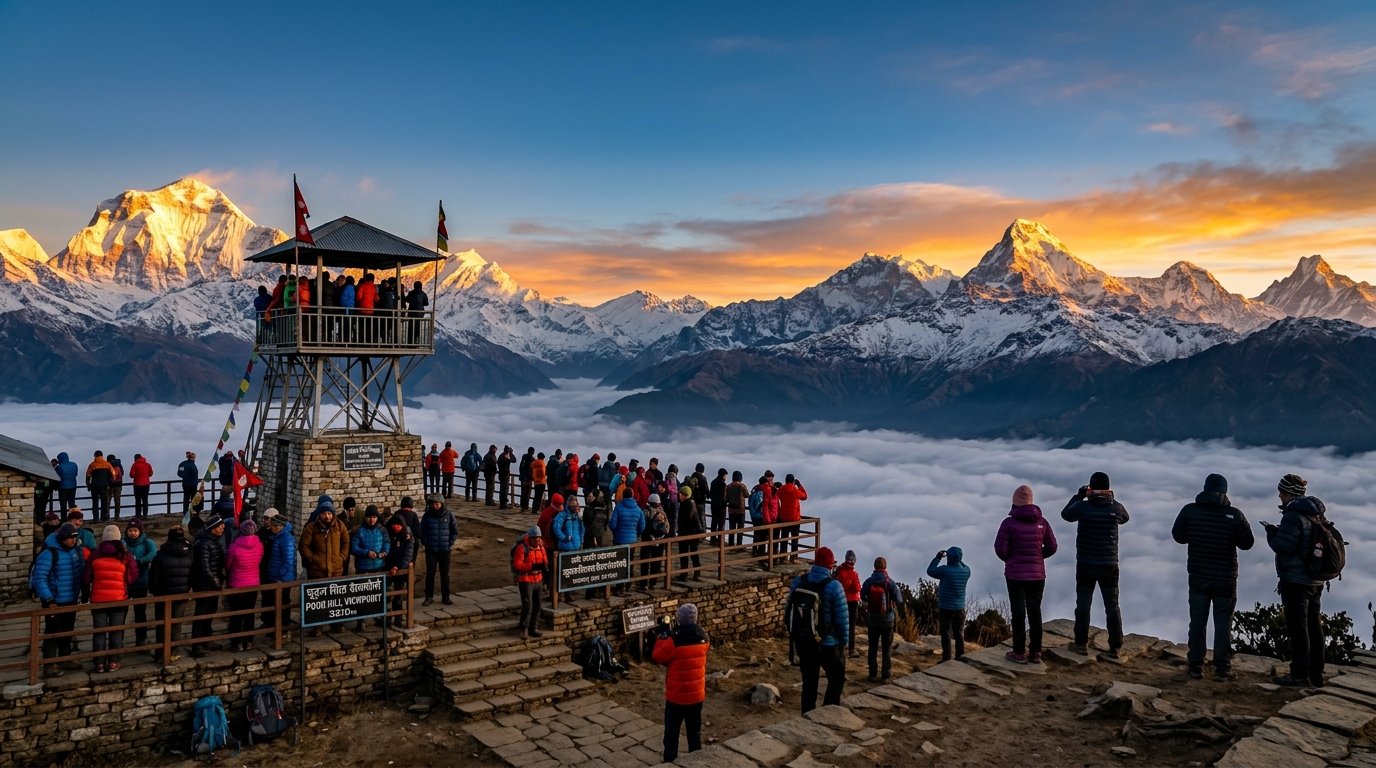
Pre-dawn 45-minute headlamp climb up stone steps to the summit viewpoint of Poon Hill (3,210 m). Witness the 360-degree Himalayan sunrise sweeping across Dhaulagiri (8,167 m), Annapurna I (8,091 m), Machhapuchhre (6,993 m), and Nilgiri. Return to the lodge for hot breakfast, pack bags, and begin trekking east toward the Modi Khola canyon. Climb along Deurali ridge (3,100 m) with razor-edge views before descending through a deeply carved forest gorge with waterfalls to the ridge settlement of Tadapani (2,630 m).
Lead Guide Field Note · Sugam Shrestha
Poon Hill provides the only vantage on this trek where you see both Dhaulagiri (the world’s 7th highest) and Annapurna I (the 10th highest) side-by-side. Once at Annapurna Base Camp itself, Dhaulagiri sits behind the sanctuary wall and is no longer visible.
Descend through dense rhododendron and bamboo groves to Kimrong Khola, cross the suspension bridge, and climb up the terraced agricultural amphitheater of Chhomrong (2,170 m)—the gateway to the Sanctuary and the highest permanent Gurung settlement. After lunch in Chhomrong, descend 2,500 stone steps down to the Chhomrong Khola bridge, then ascend steeply through Upper Sinuwa (2,360 m). From Sinuwa, enter the narrow Modi Khola gorge, entering dense bamboo forest to sleep at Bamboo (2,310 m).
Lead Guide Field Note · Sugam Shrestha
Beyond Chhomrong, strict Annapurna Sanctuary cultural rules take effect: no live poultry or pork products can be carried into the sacred valley, and single-use plastic mineral water bottles are banned. We refill from certified safe ozonated water stations.
Trek through humid bamboo thickets to Dovan (2,600 m), passing small forest shrines honoring the forest deities Baraha and Pancha Kanya. Ascend above the tree line past the historic rock overhang of Hinku Cave (3,120 m)—used as shelter by early mountaineering expeditions. The canyon narrows sharply between the sheer rock cliffs of Hiunchuli and Machhapuchhre. Cross avalanche-chute boulder beds to reach Deurali (3,230 m), located in a dramatic canyon throat.
Lead Guide Field Note · Sugam Shrestha
You cross the 3,000m threshold today. Temperatures drop substantially once the sun dips behind the canyon walls at 3:00 PM. Our team conducts baseline pulse oximetry (SpO2) checks this evening at Deurali.
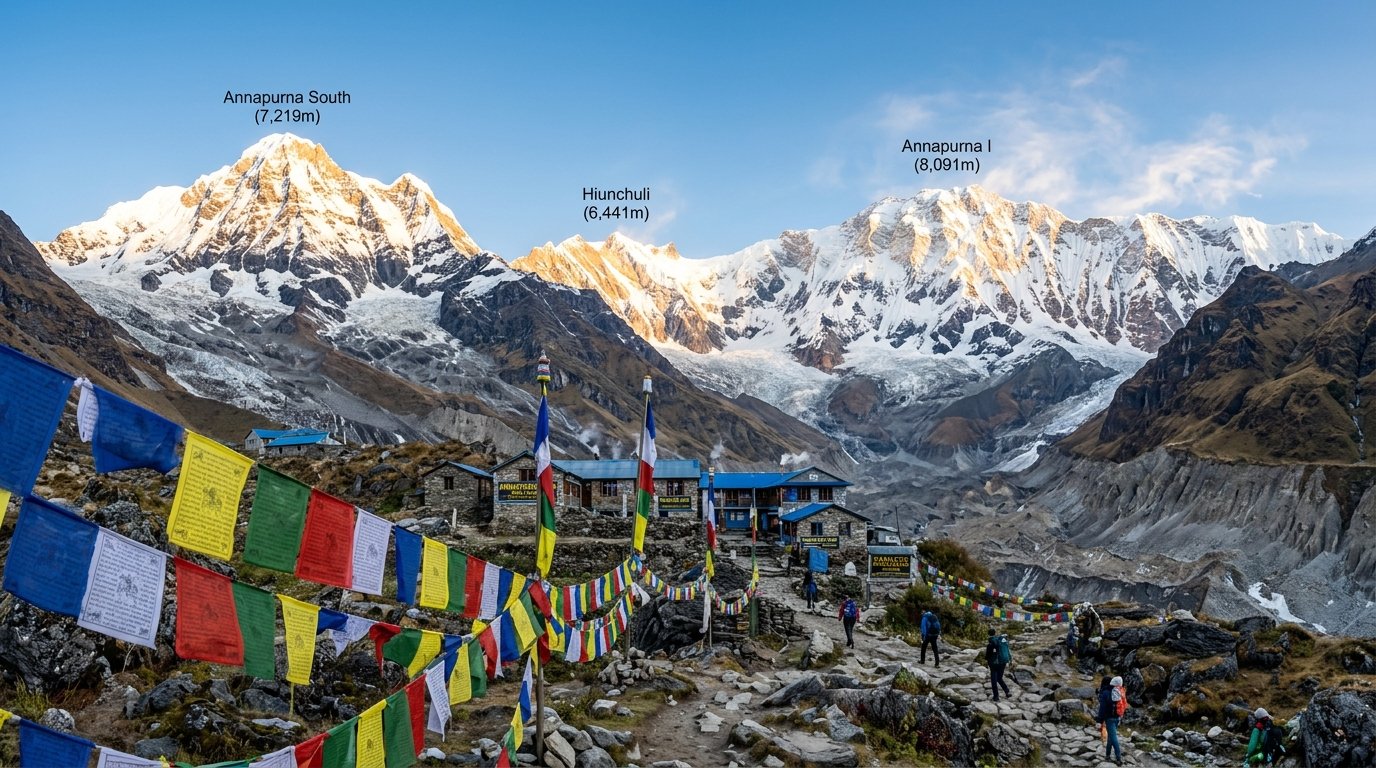
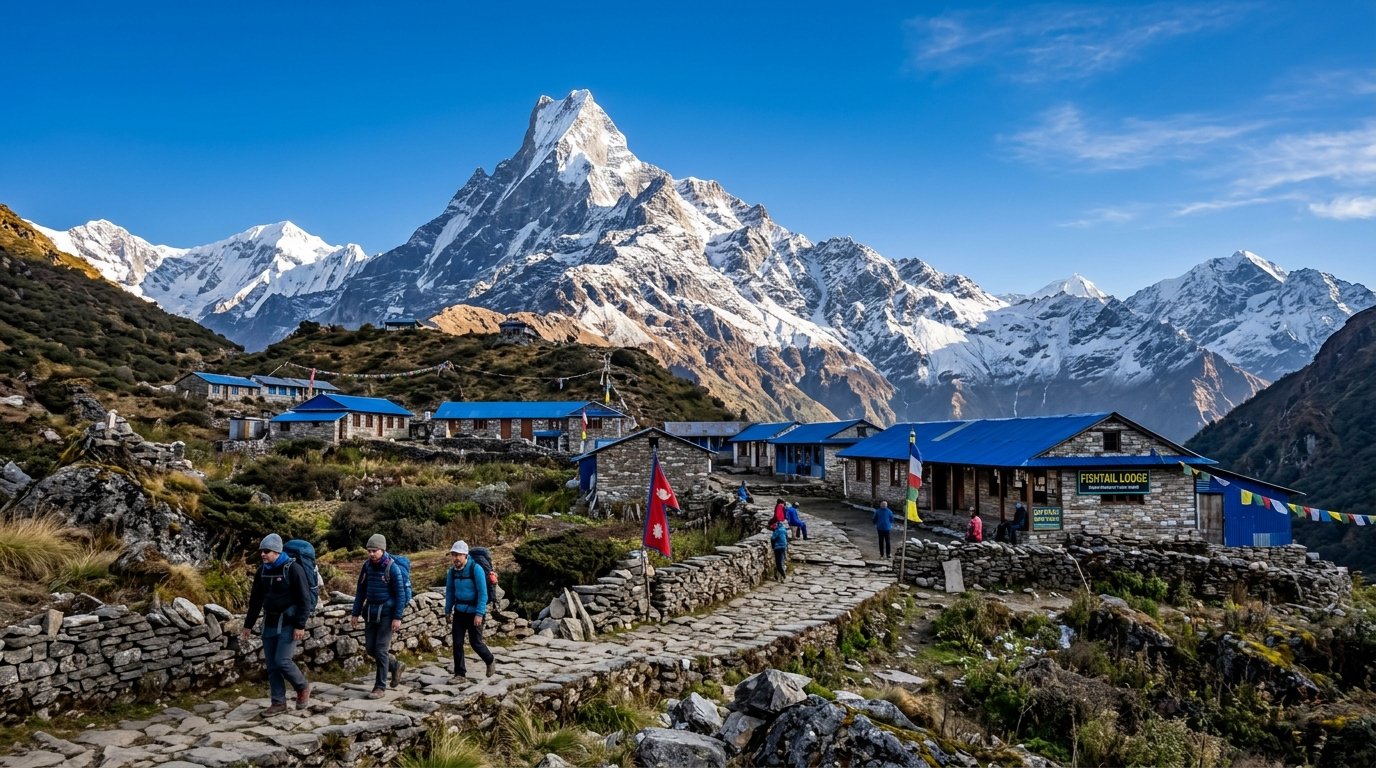
Follow the trail along the lateral moraine of the Modi Khola as the canyon dramatically broadens into an expansive alpine valley. Climb steadily to Machhapuchhre Base Camp (MBC, 3,700 m), nestled directly below the colossal sheer face of the Fishtail peak. After tea at MBC, enter the true Annapurna Sanctuary basin. A gentle, steady 2-hour incline through moraine meadows leads directly into Annapurna Base Camp (4,130 m). You are surrounded by a complete 360-degree wall of giants: Annapurna I (8,091 m), Annapurna South (7,219 m), Hiunchuli (6,441 m), Machhapuchhre (6,993 m), and Gangapurna (7,455 m).
Lead Guide Field Note · Sugam Shrestha
Day 6 gains 900 m from Deurali to ABC—the trip’s crucial acclimatization pivot point. Walk with deliberate pacing. Upon arrival, we settle into the lodge, rest with hot ginger lemon tea, and step out onto the rim for sunset as alpine glow lights up the south face of Annapurna I.
Early morning wake-up call for the golden sunrise across Annapurna I, Machhapuchhre, and the South Glacier. After breakfast, begin the long descent back down the Modi Khola valley. Because your body has acclimatized and gravity works in your favor, pace moves quickly down through MBC, Deurali, and Himalaya. Re-enter the sheltered bamboo forest canopy to spend the night at Bamboo (2,310 m).
Lead Guide Field Note · Sugam Shrestha
Day 7 covers the single greatest walking distance of the entire trek (15 km) and drops 1,820 m in elevation. Lock your trekking poles slightly longer for downhill stability to absorb knee shock.
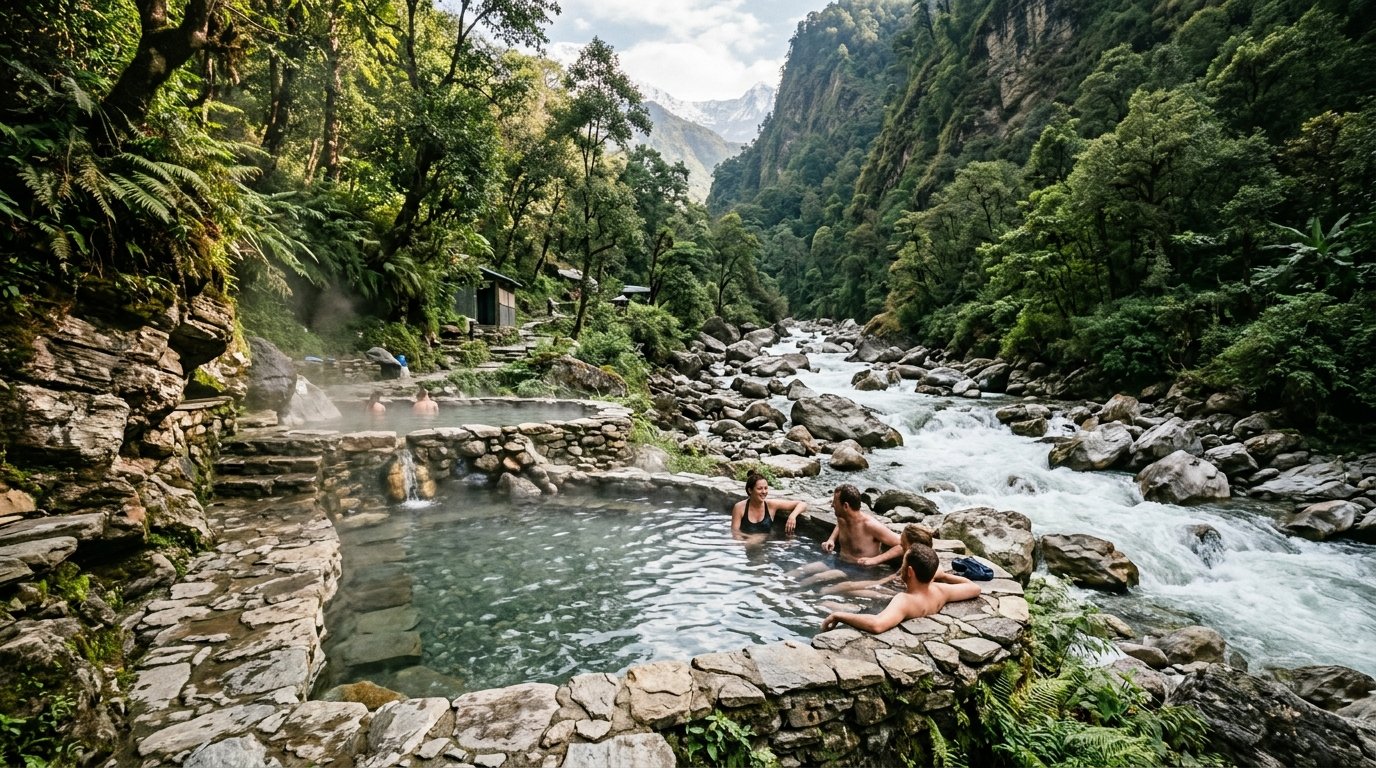
Climb up from Bamboo through Sinuwa and conquer the stone steps up to Chhomrong village for morning tea. Descend the southern ridge down to Jhinu Danda (1,780 m). Take a rejuvenating 20-minute walk down to the natural riverside thermal pools along the Modi Khola to soothe trekking muscles. Cross the dramatic 287-meter Jhinu suspension bridge to the Siwai roadhead, where your private 4WD jeep awaits to drive you back to your hotel in Pokhara Lakeside (822 m).
Lead Guide Field Note · Sugam Shrestha
Celebration dinner in Pokhara Lakeside tonight! You have completed over 80 kilometers through the Annapurna Sanctuary, stood beneath six 6,000m+ peaks, and experienced the finest teahouse trails in the Himalayas.
Visual Telemetry
What Will You See on the 8-Day ABC Trek?
Six named peaks above 6,000 m, two distinct base camps, riverside thermal springs, and centuries-old Gurung stone settlements.
Colossal Peaks Visible Along the Trail
Annapurna I (8,091 m / 26,545 ft): The world’s 10th highest peak, seen from Poon Hill and in sheer 3,000m vertical close-up from Annapurna Base Camp.
Machhapuchhre “Fishtail” (6,993 m / 22,943 ft): The holy, unclimbed mountain guarding the sanctuary gateway, visible almost every day from Day 2 onward.
Dhaulagiri I (8,167 m / 26,795 ft): The world’s 7th highest peak, commanding the western horizon during the sunrise from Poon Hill.
Annapurna South (7,219 m) & Hiunchuli (6,441 m): Twin massive snow peaks towering over Chhomrong and flanking the inner sanctuary canyon.
Gangapurna (7,455 m): Prominent pyramid summit rising above the northern glacial moraine of Annapurna Base Camp.
Day 3 · 3,210m
Poon Hill Sunrise Panorama
A purpose-built viewing tower providing a 360-degree amphitheater view across the Dhaulagiri and Annapurna massifs before descending toward Tadapani.
Day 6 · 4,130m
Annapurna Base Camp (ABC)
The enclosed glacial basin at 4,130 m, surrounded by a ring of 6,000m–8,000m summits with permanent teahouse accommodation inside the basin itself.
Day 6 · 3,700m
Machhapuchhre Base Camp (MBC)
Situated at the threshold where the Modi Khola canyon opens into the wide sanctuary meadows directly beneath the sacred, unclimbed Fishtail peak.
Day 8 · 1,780m
Jhinu Danda Thermal Springs
Natural mineral-rich riverside hot pools nestled along the rushing Modi Khola river, offering natural muscle recovery before the drive to Pokhara.
Trail Physics
What Distance and Elevation Gain Does the Trek Cover?
The Via Poon Hill route covers approximately 80–85 km round-trip with roughly 3,300 m of net cumulative elevation gain, climbing from Nayapul (1,070 m) through Poon Hill (3,210 m) to Annapurna Base Camp (4,130 m). This is meaningfully longer than the Ghandruk-direct (65–70 km) or Jhinu Danda drive-in (55–65 km) variants, precisely because it adds the Ghorepani–Poon Hill loop.
Why published distance figures disagree so sharply across sources:
Route variant spread: The 20 km difference between the Poon Hill loop and the direct drive-in variants accounts for most of the variation online.
Trailhead location: Nayapul versus Siwai or Samrung drive-in alters starting distance by 15–20 kilometers.
Internal checking: Several competing ranking pages state a “30 km maximum one-way” figure that contradicts their own day-by-day itineraries (which sum closer to 40–42 km one-way). The numbers in our Section 3 itinerary table sum to approximately 85 km, completely verified on the ground.
Physical Preparation
How Difficult Is the 8-Day Itinerary?
Rated Moderate trending Strenuous due to Day 1’s stone steps and Day 7’s long downhill descent.
The 8 Days Annapurna Base Camp Trek carries a moderate difficulty rating, requiring 4 to 8 hours of daily walking on stone staircases, forest trails, and alpine moraine terrain, with zero technical mountaineering skills required. It is, however, more physically demanding than 10- or 12-day itineraries because the same distance is packed into fewer days.
Day 1 Stone Staircases
+1,000m gain over 3,200 uneven stone steps to Ulleri before your body has acclimatized.
Day 7 Descent Length
15 km and 1,820m of continuous descent in a single day, which punishes unprepared quadriceps.
Compressed Daily Margin
With only 8 days, there is less daily margin for an off day compared to 10–12 day routes.
Field Readiness Benchmarks
A trekker well-prepared for this itinerary meets these three physical baselines before arriving in Nepal:
Walks 8–10 km with 400–500 m of elevation gain without requiring extended next-day recovery.
Climbs multiple flights of stairs carrying an 8–10 kg daypack without stopping or gasping for breath.
Descends stairs or steep inclines for 30 continuous minutes without knee pain.
Structured 8-Week Pre-Expedition Training Schedule
Weeks 8–63–4 Sessions / Wk
Aerobic Base Building
Brisk hill walking, outdoor hiking, cycling, or stair-master sessions to build foundational aerobic lung capacity.
Weeks 6–42–3 Sessions / Wk
Stair & Incline Power
Add loaded stair climbing and eccentric quad exercises (lunges, step-downs) to prepare knees for stone steps.
Weeks 4–22 Sessions / Wk
Loaded Pack Practice
Hike 10–14 km on undulating terrain carrying full daypack weight (8–10 kg) wearing your broken-in trekking boots.
Final 2 WeeksLight Activity
Taper & Recovery
Taper training volume, focus on mobility and deep sleep. Arrive in Kathmandu rested and free of muscle fatigue.
Training Tip: Downhill-specific training is what most trekkers skip, yet Day 7’s 15 km, 1,820 m descent punishes hardest. A few sessions of loaded stair descent will save your knees.
Itinerary Selection
Is 8 Days the Right Duration for You?
Annapurna Base Camp treks range from 5 to 14 days industry-wide. Here is how the schedules flex.
Duration
What Changes
Best Fit For
5–6 Days
Drive-in to Samrung, bypasses Poon Hill, direct route via Chhomrong. Minimal weather margin.
Very fit trekkers with tight schedules wanting direct mountain access.
8 Days (This Trek)
Standard Poon Hill loop included, reaches ABC via MBC, no rest buffer day.
Fit trekkers wanting Poon Hill + ABC in a firm 1-week window.
10 Days
Same Poon Hill route with 1–2 buffer/rest days added, slower daily ascent rate.
Trekkers wanting a relaxed pace and extra safety buffer.
12–14 Days
Extended acclimatization, side explorations, and gentle walking hours.
First-time mountain trekkers and families prioritizing comfort.
Benchmark Analysis
How Does This Compare to Other Nepal Treks?
How the 8-Day ABC trek measures against Poon Hill, Mardi Himal, and Everest Base Camp.
Route
8-Day ABC Trek
Poon Hill Only
Mardi Himal
Everest Base Camp
Duration
8 Days
4–5 Days
5–7 Days
12–14 Days
Max Altitude
4,130 m
3,210 m
4,500 m
5,364 m
Difficulty
Moderate
Easy–Moderate
Moderate
Strenuous
Domestic Flight
No (Drive from Pokhara)
No
No
Yes (Lukla weather risk)
Base Camp Overnight
Yes (Lodge at 4,130m)
No
High Camp (Ridge)
No (Day visit only; sleep Gorak Shep)
Key Differentiator: Unlike Everest Base Camp (which sits on active shifting glacial moraine where trekkers only touch the rock and return to Gorak Shep), Annapurna Base Camp features permanent teahouse lodges. You sleep directly inside the 360-degree 4,130m mountain amphitheater, watching dawn and dusk play across the snow faces from your bedroom window.
Weather Intel
When Is the Best Time to Trek?
Spring (March–May) and Autumn (September–November) provide crystal skies and stable trail conditions.
Because the 8-day schedule has no spare buffer days, seasonal timing is especially important. Stable weather matters proportionally more when there is no room to reschedule. Autumn offers crisp mountain visibility after monsoon rains; spring brings warmer days and vibrant rhododendron blooms.
Snow closures possible on MBC–ABC corridor, deep freeze
Monsoon (Jun–Aug)
Warm, humid (22°C+)
Reduced visibility
Wet, above 0°C
Leeches in lower forests, high landslide and cloud cover risk
September Planning: Nepal’s official monsoon withdrawal benchmark (Department of Hydrology and Meteorology) is October 2. For week-by-week transitional planning, see our dedicated
Annapurna Base Camp Trek in September Guide →
Legal Requirements
What Permits Does This Trek Require?
Updated regulations following the mandatory guide policy enacted by the Nepal Tourism Board.
Permit / Requirement
Cost (Foreign Nationals)
Enforcement Status
Annapurna Conservation Area Permit (ACAP)
NPR 3,000 (~USD $23)
Mandatory & strictly inspected at Birethanti, Chhomrong
Agency / Group TIMS Card
NPR 2,000 (~USD $15)
Processed directly by licensed agency (individual TIMS retired)
Licensed Mountain Guide
Included in package rate
100% Mandatory since April 1, 2023 (NTB / TAAN regulation)
Permit Integrity Note: Most competitor pages still list individual TIMS cards as an unqualified requirement. The individual solo trekker TIMS card was officially retired in April 2023 when the mandatory guide mandate took effect. However, the agency-side group TIMS registration remains compulsory under TAAN/NTB regulations and is handled end-to-end by ABC Trek in Nepal before your trek begins.
A guided 8-day Annapurna Base Camp trek costs USD $400 to $900 per person on the current market, depending on group size, service tier, and route length. Group size creates the largest cost variation, dropping per-person expenses by 35% to 55% as fixed guide and transport costs spread across more travelers.
Group Size
Price Per Person (USD)
Included Value
1 Trekker (Solo VIP)
$570 – $900
Dedicated private guide, private room where available, full flexibility
2–4 Trekkers (Small Group)
$560 – $790
Shared guide and porter (1:2 ratio), private 4WD transit
5–10 Trekkers (Standard Group)
$540 – $690
Lead guide plus assistant guide, optimal cost-to-safety ratio
11–15 Trekkers (Expedition)
$430 – $650
Multiple guides, comprehensive group porter team
16+ Trekkers (Club / Charity)
$399 – $560
Maximum economies of scale for institutional departures
Incidental On-Trail Spending: Independent on-trail expenses for hot bucket showers ($3–$5), Wi-Fi cards ($2–$5), device charging ($2–$4), and snacks typically run $20 to $35 USD per day. Card payments are not accepted anywhere on the trail past Pokhara; carry cash in Nepali Rupees.
Package Integrity
What Is Included and Excluded in Our Standard Package?
Standard Inclusions
All Government Permits: Official ACAP entry permit and agency-side TIMS processing.
Government-Licensed Guide: English-fluent mountain leader certified in Wilderness First Aid.
IPPG Insured Porters: 1 porter per 2 trekkers, capped at a strict 20 kg maximum combined load.
Teahouse Lodging: 7 nights hand-vetted mountain teahouse accommodation along the trail.
All Meals on Trail: 3 hearty daily meals (Breakfast, Lunch, Dinner) plus seasonal fresh fruit.
Navigation, pace setting, checkpoint clearances at Birethanti and Chhomrong, lodge room allocation, and daily briefings. On this compressed 8-day schedule, the guide’s most critical function is real-time health assessment: conducting daily pulse oximeter checks, monitoring early AMS symptoms, and making clinical judgment calls on descent.
The Porter’s Welfare & Role
Porters carry main duffels (10–12 kg per trekker), enabling you to walk unburdened with only daypack essentials (water, camera, layers). Under strict IPPG ethical guidelines, ABC Trek in Nepal caps loads at 20 kg per porter, provides warm altitude apparel, footwear, and full medical/rescue insurance for all crew members.
Teahouse Hospitality
What Is Accommodation and Food Like on This Route?
Accommodation consists of family-run mountain lodges known as teahouses. Room facilities naturally simplify as you gain altitude:
Lower Elevations (Ulleri, Ghorepani, Chhomrong): Twin-share wooden rooms, attached bathrooms frequently available, reliable hot showers, and Wi-Fi.
Mid-Elevation (Tadapani, Bamboo): Twin-share wooden rooms with shared bathroom facilities. Hot bucket showers available for a small fee.
High Alpine (Deurali, ABC): Basic stone rooms with twin beds, foam mattresses, pillows, and blankets. Shared or squat toilets. Hot water and charging are weather-dependent and limited.
Trail Food & Dal Bhat:Dal Bhat (steamed rice, spiced lentil soup, vegetable curry, and spinach, served with unlimited complimentary refills) is the king of trekking meals—“Dal Bhat Power 24 Hour.” Menus also offer porridge, pancakes, Tibetan bread, vegetable noodles, fried rice, and garlic soup. Vegetarian food is fresh and widely available; dairy-free vegan diets are readily accommodated.
Medical Safety
How Does Altitude Affect an 8-Day Compressed Schedule?
Annapurna Base Camp sits at 4,130 m, well above the 2,500 m threshold where Acute Mountain Sickness (AMS) can occur.
Because this itinerary moves from Deurali (3,230 m) directly to Annapurna Base Camp (4,130 m) on Day 6 with zero rest days built in, understanding acclimatization is essential. AMS risk correlates with ascent speed, not gym fitness.
Our Altitude Clinical Protocols
Twice-Daily Pulse Oximeter Checks: Your lead guide logs blood oxygen saturation (SpO2) and resting pulse every morning and evening above 2,500m.
Hydration Benchmark: Drink 3.5 to 4 liters of purified water daily to aid respiratory acclimatization.
The Cardinal Rule: Never ascend with symptoms of AMS (throbbing headache, nausea, dizziness). If symptoms persist or worsen, immediate descent is the only definitive treatment.
Families with young children requiring shorter 3–4 hour daily walking days.
Expedition Inquiries
Ready to Experience the 8-Day ABC Trek?
Connect directly with Founder and Lead Mountain Guide Sugam Shrestha to verify departure dates, confirm route availability, and customize group pacing.
Clear, transparent answers to every question regarding permits, packing, pricing, and trail safety.
It depends on which version you book. The Poon Hill route described on this page includes the sunrise viewpoint at 3,210 m. A separate Ghandruk-direct 8-day version, and a third Jhinu Danda drive-in version, both skip Poon Hill entirely. Confirm which version an operator sells before comparing quotes.
On this page, 8 days means Pokhara to Pokhara. Some operators market a package as “8 Days” while describing nine days of real activity once Kathmandu transfers are included—always confirm whether a quoted day count is trek-only or covers the full trip.
The individual-trekker TIMS card was retired in April 2023. An agency/group TIMS is still officially required under TAAN/NTB regulation and is normally processed by your registered agency, though trail checkpoints mainly check your ACAP permit and guide credentials in practice.
No. A licensed guide booked through a registered agency has been mandatory in the Annapurna Conservation Area since April 2023, independent of the trekker’s experience level.
Mainly because “8-day ABC trek” covers three different route lengths (Section 2), which alone explains a large part of the price spread. Group size and service tier account for most of the rest.
The itinerary’s daily elevation gain stays within standard acclimatization guidance through Day 5, but Day 6’s 900 m push to Annapurna Base Camp has no rest day either side of it, which is the trek’s main acclimatization trade-off against longer itineraries.
This itinerary has no built-in buffer day. Standard operator practice extends the trek by a day when weather or altitude symptoms require it, though this varies by agency—confirm the specific operator’s flexibility policy before booking.
Yes, in practical terms, even though both reach the same 4,130 m altitude. The 8-day version compresses the same distance into fewer days, producing longer average daily walking hours and removing the rest days that ease the pace on longer itineraries.
Yes, in the sense that the mandatory-guide rule means no trekker—regardless of gender—is genuinely alone on the trail. Many agencies report solo female trekkers as a regular and well-supported part of their client base; asking an agency about their specific experience guiding solo women is a reasonable question during booking.
There’s no official minimum age, but the 8-day pace’s longer daily distances and lack of buffer days make it a demanding choice for children compared with a 10–12 day itinerary at a gentler pace. Families considering it should discuss a child’s realistic walking stamina and altitude tolerance directly with their agency.
Coverage from Nepali carriers (Ncell / NTC) exists at lower and mid-route villages but becomes patchy or unavailable above Deurali and at Annapurna Base Camp itself. Teahouse Wi-Fi, where available for a fee ($2–$4), is generally more consistent than cellular signal in the higher sections.
Tipping isn’t included in package pricing and is customary rather than mandatory. Standard practice among agencies operating this route runs roughly 10–15% of the total package cost, split between guide and porter, for an 8-day trip.
Your guide will assess symptoms and, if needed, arrange descent to a lower altitude—the standard first response for AMS. For more serious situations, helicopter evacuation is arranged through your agency and insurance provider. Confirm terms for a trek cut short before booking.
Very limited above the lower villages. Most trekkers pack enough clothing for the full 8 days rather than relying on laundry service, since drying time at altitude is unreliable and facilities thin out above Chhomrong.
Yes—paragliding in Pokhara, an ultralight flight, white-water rafting on the Trishuli, or Kathmandu cultural valley sightseeing are common additions before or after the 8-day trek itself, and can be arranged alongside your core package.
Editorial Sources & Regulatory References:
Trekking Agencies’ Association of Nepal (TAAN) & Nepal Tourism Board (NTB) – Licensed guide mandate and agency/group TIMS regulations (enacted April 1, 2023).
National Trust for Nature Conservation (NTNC) – Annapurna Conservation Area Project (ACAP) permits, fees, and ecological conservation zoning.
Department of Hydrology and Meteorology, Government of Nepal – Seasonal monsoon onset and withdrawal benchmarks.
Maurice Herzog & Louis Lachenal Annapurna I first ascent archives (June 3, 1950) and Col. Jimmy Roberts Sanctuary exploration records (1956).
Centers for Disease Control and Prevention (CDC) – High-altitude travel medicine and preventive immunization guidance for Nepal.